Era, cuando no existía el coronavirus, el blog de Fernando Machuca, un aficionado a los deportes, con maestría y doctorado en informática, apasionado por el Big Picture integral de los deportes profesionales y las industrias deportivas como un motor de crecimiento mundial. Ahora este blog es mi trinchera en la guerra contra el coronavirus.
Every day we experience an explosion of new knowledge of exceptional excellence in emerging technologies (e.g., AI, 5G, Robotics, Automation, IoT, lithium-ion battery ) and in multidisciplinary knowledge (e.g., Leadership, management, strategy, innovation, creativity, teamwork, organizational culture, marketing, resilience, uncertainty, disruption, business models, supply chains, customer management) that best exploits those technologies and knowledge in general.
"genioux facts" (@geniouxfacts) is Bombshell, Breaking and Viral Knowledge deduced and extracted from cutting-edge knowledge containers of different types (e.g., Articles, magazines, books, videos, international organizations, universities, research groups).
"genioux facts" (blog.geniouxfacts.com, geniouxfacts.com) is an essential knowledge extractor that deduces and extracts relevant knowledge from cutting-edge knowledge containers of different types (e.g., Articles, magazines, books, videos, international organizations, universities, research groups).
"genioux facts" are essential knowledge for "infinite learners", business leaders or leaders in general that keep pace with change and avoid disruption, enjoy learning and feel a constant need to acquire new skills. [genioux fact extracted from HBR]
The "genioux facts" form a fundamental basis to build a better world for all in the Digital Era.
The thinking to produce the "genioux facts" is on a plane outside of where the problems have been created.
The "genioux facts" are free of biases, any struggle of powers, of political polarization, of complex interests, and fear.
The value of the innovation of "genioux facts":
Fuel your growth with essential knowledge that:
facilitates your learning process.
brings more relevant insights to improve the quality and speed of your thinking.
helps you hone your thinking skills.
enriches you and therefore makes you smarter; and
accumulates knowledge that could grow exponentially.
Empower people, companies, organizations of any kind, countries and cities, to build a much better world for everyone in the Digital Era.
Feed the knowledge space where everyone's slices of genius can be unleashed and harnessed and turned into works of collective genius.
Empower people and organizations to WIN THE CROSS-CUTTING CHALLENGES we face: 1) Building a new, better and sustainable world for all; 2) Unlimited growth in the Digital Age; and 3) Solutions to the risk of coronavirus and other viruses.
Pinpoint the most relevant real and false problems on earth.
Mark out the opportunities (e.g., disrupt), challenges (e.g., get your best Digital Transformation) and risks (e.g., be disrupted) of the Digital Era.
Trace the fundamental facts of the state of the art of the Digital Era, about emerging technologies and science.
Teach about the new paradigm (e.g., the need for life-long learning) in the Digital Era and open the way to reinvent yourself.
Enable the growth of each one as a unique leader.
Increase all the intelligences (e.g., general, spiritual, emotional, social, and human-machine intelligences).
The NBA announced that Mexican professional club Capitanes will join the NBA G League in 2020-21. Commissioner Adam Silver: “I think it’s an important signal to the market just how important we view the entire country of Mexico and all of Latin America”.
Llamas, Silver and several key figures from both sides want to strengthen Mexico’s ability to produce, and not just receive, NBA talent. As revolutionary as the G League announcement is, they recognize the native talent must be recognized and treasured long before the professional playing age.
“We are looking for talent, that’s for sure,” said NBA Mexico VP and Managing Director Raul Zarraga. “This G League team is part of this basketball ecosystem that we are building around the nation. Now we are creating an alternative for them so in the future they can see themselves living basketball and perhaps playing in the NBA.”
The league stands waiting and ready for Mexico’s next wave of talent.
Luka Doncic and Ricky Rubio represent the most recognizable Spanish-speaking NBA players in Mexico City this week. They also hail from countries that were not always synonymous with basketball, but that have recently become international powerhouses.
Doncic helped lead Slovenia to an unexpected 2017 Eurobasket Gold Medal. Rubio’s Spanish national teams boast two Eurobasket golds, two Olympic medals and the 2019 FIBA World Cup gold medal.
This begets the question: if Slovenia (a country with just one million people) and Spain (overwhelmingly inclined to soccer) can produce golden eras of basketball, why not Mexico?
“What is our dream? To bring another Mexican to the NBA, of course, very soon,” decalred Capitanes co-owner Gilberto Hernandez.
NBA Academy Latin America will play a vital role in generating that movement. The basketball training program, backed by the NBA and the Mexican government, develops talent from the Caribbean, Mexico, Central American and South America.
The academy projects to be a destination for top-tier young prospects, similar to many such institutions in Europe that helped develop Doncic and other European talents that moved on to the NBA.
“This is the next step in this market,” Silver said. “We’re learning we need to be on the ground, we need to be local, we need to get basketballs in the hands of young boys and girls. We need to work particularly with the elite players.”
#NBAMexicoCityGames MAVERICKS at PISTONS | FULL GAME HIGHLIGHTS | December 12, 2019
Luka Doncic EXPLODED for a 41-PT, 12-REB, 11-AST triple-double as the Dallas Mavericks defeated the Detroit Pistons 122-111 to open #NBAMexicoCityGames 2019. Seth Curry scored 30 PTS (18 in the 2Q), and added 7 REB. 4 AST and 2 STL. Andre Drummond put up 23 PTS, 15 REB and 3 STL for Detroit.
Wikipedia, Nadal has won 19 Grand Slam singles titles, the second-most in history for a male player
Rafael "Rafa" Nadal Parera (born 3 June 1986) is a Spanish professional tennis player currently ranked world no. 1 in men's singles tennis by the Association of Tennis Professionals (ATP).
Nadal has won 19 Grand Slam singles titles, the second-most in history for a male player, as well as a record 35 ATP Tour Masters 1000 titles, 20 ATP Tour 500 titles and the 2008 Olympic gold medal in singles. In addition, Nadal has held the world no. 1 ranking for a total of 200 weeks, including being the year-end no. 1 five times. In majors, Nadal has won a record twelve French Open titles, four US Open titles, two Wimbledon titles and one Australian Open title, and won at least one Grand Slam every year for a record ten consecutive years (2005–2014). Nadal has won 84 career titles overall, including the most outdoor titles in the Open Era (82) and a record 59 titles on clay. With 81 consecutive wins on clay, Nadal holds the record for the longest single-surface win streak in the Open Era.
Nadal was a member of Spain's winning Davis Cup team in 2004, 2008, 2009, 2011 and 2019, and has a 29-win streak and 29–1 record in singles matches at the event. In 2010, at the age of 24, he became the seventh male player and the youngest of five in the Open Era to achieve the singles Career Grand Slam. Nadal is the second male player after Andre Agassi to complete the singles Career Golden Slam, as well as the second male player after Mats Wilander to have won at least two Grand Slams on all three surfaces (grass, hard court and clay). He has received the tour Sportsmanship Award two times and has been named the ATP Player of the Year five times and the ITF World Champion four times. In 2011, Nadal was named the Laureus World Sportsman of the Year.
ATPTour, Nadal Officially Opens Academy In Manacor
Rafael Nadal officially opened the Rafa Nadal Academy by Movistar in his hometown, Manacor, Mallorca, on Wednesday. The high-performance centre combines tennis and education, so that students can continue their pathway to professional tennis without having to neglect their academic studies.
“My future is here,” said Nadal. “I don’t imagine myself living away from Mallorca. The sport is my passion and creating this tennis academy is the most important part. You can also play lots of different sports here. I believe this is a centre that kids need. I will be very involved.
The Rafa Nadal Academy by Movistar is equipped with the latest technology, including supervised residency exclusively for students, an American International School for children aged 10 to 18 years of age, and a clinic specialising in sports medicine, physiotherapy and nutrition. There are also 26 indoor and outdoor tennis courts, a fitness centre, two swimming pools (indoor and outdoor), mini-football pitches, three regulation multi-sport courts, 10 paddle tennis courts, a restaurant and café bar, pro shop and gardens.
Official Web Site, Toni Nadal, The people that excel in life are those that persevere
Rafa Nadal International School
Rafa Nadal has always been concerned by the fact that it is difficult to prepare for life as a professional tennis player at the same time as continuing studies and going to university. Many tennis players are forced to leave school before they ever reach the stage where they are ready to take university entry access courses, and this can turn out to be a long-term handicap, limiting their future options. For this reason, Rafa was keen to create an international school that offers the necessary flexibility for tennis and studies to be truly compatible.
Furthermore, Rafa has always been loyal to a set of values that have helped him throughout his career, and which he considers essential for both personal and Athletic development. Incorporating these values to the educational program of the Academy has been a priority since the conception of the project.
The fruit of these concerns is the Rafa Nadal International School, which is situated within the Rafa Nadal Academy by Movistar and allows athletes to combine tennis and studies. Each student will be prepared to face the university entrance system – including access to American institutions through scholarships. The mission and philosophy of the school incorporate the very values that have propelled Rafa during his career.
Just two days after leading team Europe in the Laver Cup, world tennis legend Björn Borg has visited the Rafa Nadal Academy by Movistar for the first time. During his three-day stay, the ex-world number 1 and winner of 11 Grand Slams also had the chance to enjoy the facilities at the Rafa Nadal Sports Centre.
“I’m very happy to have come to the Rafa Nadal Academy. I’d heard good things about this place, but spending three days here has confirmed it, it’s incredible. I have really enjoyed myself. I would invite you all to come and see it and to play here. The quality of the training is very good and I think they’ve done a great job. This is why my son has come here, I’m very happy about that and I hope that many others come in the future because the Academy is very good”, said the six-time French Open champion.
His son, Leo Borg, who is currently training at the Rafa Nadal Academy by Movistar for a few weeks, is considered (at just 16 years of age) to be one of the young promises of Swedish tennis and one of the players destined to lead the new generation of tennis in his country.
TennisWorldUSA, Rafael Nadal to open tennis academy in Kuwait in 2020
Opened in 2016, Rafa Nadal Academy by Movistar has gathered some of the leading juniors in the world, offering them a chance to work at the top-tier facility with best coaches and under the close eye of the 19-time Major champion Rafael Nadal himself.
Besides the Academy, Nadal also launched the "Rafa Nadal Tennis Centre" in Mexico and Greece, with Kuwait as the next destination where he wants to improve the level of tennis and open it for kids and professionals.
Joining forces with property developer Tamdeen Group, Rafa Nadal Academy by Movistar provides a brand-new Shaikh Jaber Al Abdullah Al Jaber Al Sabah International Tennis Complex in Kuwait, one of the most significant sports initiative developed with Kuwait Public Authority for Sport.
State of the art complex will include 18 courts, eight outdoor, eight indoor, open court with 1,500 seats and covered arena with more than 5,000 seats. A five-star hotel, restaurants and diverse selection of retail outlets will also be a part of the complex that should become the gathering point of the Kuwait tennis federation, giving them a chance to provide a future champion from this region.
ENSURE CREDIBILITY OF SPORTING RESULTS AND PROTECT ATHLETES
Cycling is a wonderful sport in which the exploits of riders strike a chord with the watching world. To ensure that people continue to follow our sport with passion, we must guarantee the credibility of race results. Our credibility has been undermined by numerous doping scandals and cases of suspected technological fraud. The UCI must now shoulder this responsibility, which is vital to the future of cycling.
1. Strengthen the preventive measures against technological fraud
a. Implement an effective and credible action plan
Detected at the 2016 UCI Cyclo-cross World Championships, the first case of technological fraud provided proof that mechanical doping was a reality. More cases have since been uncovered in amateur cycling. The UCI will take all necessary measures in stepping up the fight against technological fraud by implementing a credible and effective plan. The future of our sport depends on it.
Use all existing technological resources to make controls tighter (2018).
Assess the possibility of imposing stiffer penalties, both on athletes, their entourages and teams (2018).
Encourage nations to impose specific criminal penalties (2018-2022).
Analyse performances so that controls can be targeted (2018-2022).
b. Develop verification tools and have them tested by independent laboratories
We must always keep abreast of technological developments and miniaturisation. We must prioritise the search for the most appropriate technological control solutions so that we can keep the pressure up on cheats. The UCI will carry out controls using equipment approved by independent laboratories, and the funding needed to roll out these technologies will be made available.
Develop a new generation tablet that is more efficient and cheaper and thus more likely to be used around the world by our National Federations (2019).
Use X-ray technology with recognised partners in checking bikes before and after races (2018).
Conduct more thorough checks by taking bikes apart if necessary (2018-2022).
Develop onboard magnetometer technology to prevent, in real time, the possible use of electric aids in competition (2020).
Have measuring tools validated by scientifically renowned, independent laboratories (2018-2020).
2. Contribute to anti-doping efforts worldwide
a. Continue to innovate in the fight against doping and maintain good rapport with the World Anti-Doping Agency (WADA) and the IOC
The doping scandals of recent years have saddled cycling with a very negative image. Our sport has genuinely grown in terms of awareness and the UCI has been very coherent in its efforts to tackle the problem. Our Federation has been a global leader in this respect. It was the first to introduce anti-doping controls, to carry out analyses detecting the presence of EPO, to measure haematocrit levels, to introduce the biological passport, and to delegate its anti-doping programme to an independent body: the Cycling Anti-Doping Foundation (CADF).
The fight against doping is ongoing, however. It is a fight that needs to be stepped up, in collaboration with the main stakeholders: WADA, the IOC and government authorities.
At the meeting of its Executive Commission on 1 June 2016 the IOC announced that it will continue to advocate that all tests be carried out independently of sporting organisations and that national and international anti-doping programmes be harmonised under the supervision of a new body. The UCI has already taken action in this respect by creating the CADF. Nevertheless, we must keep on innovating to become even more effective in this fight.
Assess the possibility of opening the CADF up to other sports (2020-2022).
Work with the International Testing Agency (ITA) set up by WADA and the IOC on technical issues and information gathering (2019).
Demand that the World Anti-Doping Code be amended so that riders returning “positive” or “abnormal” test results are provisionally suspended. (2018-2020).
Consolidate, if necessary, the process guaranteeing independence in the legal management of the Anti-Doping Rule Violations (ADRVs) (2020-2022).
Draft a “clean cycling” charter and put it before cycling’s stakeholders (2019).
Create a link between the number of ADRVs committed by countries and their Olympic Games quota places (2022-2024).
b. Continue innovating and roll out a doping prevention plan
While some National Federations have always been at the forefront of the fight against doping, others have lagged and held back by deep-rooted doping cultures. Education and prevention policies thus need to be strengthened and innovative actions and experiences shared.
Ensure cycling takes the lead in the fight against doping by means of innovative and ground-breaking initiatives (2018-2022).
Set up a doping prevention plan in conjunction with administrators, technical staff, fitness coaches and young riders (2018-2022).
Set up a post dedicated to doping prevention (2020).
Request that certain targeted National Federations come up with an education and anti-doping plan (2018-2022).
Implement a specific initiative in South and Central America in conjunction with WADA, the National Anti-Doping Organisations (NADOs), Regional Anti-Doping Organisations (RADOs), the Pan American Cycling Confederation (COPACI) and our National Federations (2019-2022).
c. Support the extension of the Prohibited List of substances
WADA determines which products should go on the Prohibited List. A glance at the List reveals that some products that have been scientifically proven to have an effect on the performance of cyclists continue to be permitted. We must campaign hard for the List to be extended to include certain products.
Explore, along with WADA, the possibility of preventing the use of certain nonprohibited medications in competition, in view of their health effects (2018-2019).
Demand that tramadol and other pain-relief medications be prohibited in cycling (inclusion in section P1: “Substances prohibited in certain sports) (2018-2019).
Call for the regulation of prohibited substances and for methods to be harmonised by enforcing a single mode of prohibition: “at all times and in- and out-of competition” (2019-2020).
3. Protect athletes
a. Establish an independent regulatory medical monitoring system
Shaken to its core by a series of doping scandals between 1995 and 2010, the sport of cycling subsequently adopted a policy that focused on the fight against this scourge rather than on medical fitness, which is oriented towards safeguarding the health of athletes and gauges the effects of taking certain permitted and prohibited substances.
Integrated the IOC’s Medical and Scientific Commission (2020).
Set out a specific medical fitness policy for the benefit of athletes (2018-2019).
Engage in independent regulatory medical supervision of teams, applicable in every country (2019-2020).
Recruit a UCI Medical Director, a full-time doctor who is responsible particularly for coordinating this supervision and providing a preferred point of contact with teams and other stakeholders (2018).
Create an epidemiological database of medical fitness and biological criteria and which respects medical confidentiality (2019-2022).
Embark on and promote the development of research into cycling-related epidemiology and medicine, particularly for the benefit of lesser-known disciplines (2019-2022).
Develop the relevant medical fitness criteria (2019-2022).
Pool blood testing with that carried out by the CADF for the biological passport, with a view to cutting down the number of actual tests conducted and reducing costs (2018-2019).
Remind team doctors that they are required to approve local cortisone injections and to prescribe a minimum eight-day suspension from work and competition (2019).
Introduce a no-start rule in the event of inadequate parameters, such as a very low cortisol test reading, with a suspension from competition (2019).
Approve the use of easily accessible matrices other than blood (or urine) with a view to identifying biological criteria for non-starts (2019-2022).
Improve, if necessary, the administration of Therapeutic Use Exemptions (AUT) in conjunction with WADA (2019).
b. Guarantee equal opportunity for all athletes
It is essential that the UCI guarantees that athletes are able to compete on an equal footing with each other and that the athlete is more important than the equipment used. In response to the laxity of recent years, our Federation must take a stricter line in ensuring that every athlete has the same opportunities, while also ensuring there is a place for continued innovation.
Review procedures for the approval of equipment (2019).
Introduce a rule that states that only equipment launched on to the market by 1 January at the latest may be used for competitions, in particular, for the Olympic Games (2019).
Ban the use of prototypes in competitions (2019).
Draft a strict procedure governing the use of new equipment in competition (2018).
c. Enhance race safety and reduce the risk of accidents
Race safety is an essential factor in protecting riders. In recent years there have been too many accidents that could easily have been avoided had stricter rules been in place. The growing number of urban developments has also made competitive road cycling more dangerous. The UCI, which is already dealing with this issue, must improve race safety further still in conjunction with all stakeholders.
Make race safety a priority (2018-2022).
Carry out a scientific study on the rise in the number of race falls and on the reasons for them so that the necessary conclusions can be drawn (2019-2020).
Consolidate the action plan drawn up by the UCI, in collaboration with race organisers, while also taking riders’ concerns into consideration (2020).
Alter the size of the peloton in response to race conditions (2020).
Stiffen the penalties imposed in the event of safety rules being violated (2020).
Make a decision on the use of disc brakes with a view to enhancing safety (2018).
4. Develop a policy framework on the risks posed by sports betting
a. Strengthen regulations on sports betting
b. Work with national governments, institutional bodies and private partners to monitor betting
c. Consider the possibility of regulating communication with riders during races
French stars across the peloton applauded the unconventional route short on time trials and packed for of surprises.
Absent this year are the prologue, team time trial or even a longer, flatter individual time trial. The route’s lone test against the clock is a climbing route ending high in the Vosges on the Planche des Belles Filles. Perhaps not coincidentally, the penultimate stage is just down the road from the home of Thibaut Pinot.
Thibaut Pinot, Groupama-FDJ
“At first glance, it’s an ideal Tour route for me.”
“I can dream of doing even better than last year. I am more motivated than ever to prepare for the race better than I ever have before.”
“If I had been able to draw the time trial out myself on a map, this would have been it.” “The cherry on the cake is the time trial in the Vosges. I know the roads like the back of my hand. I hope to be playing a big role in the decisive moment of the Tour.”
“The big mountains are hard and selective, but even the medium-mountain stages are challenging. There will be a lot of room to attack.”
“I hope to be at an even a better level than I was this year. This route excites me and motivates me.”
Julian Alaphilippe, Deceuninck-Quick-Step
“Suddenly I was the leader and everyone started dreaming, even me, I’d be pedaling away thinking more and more about it,” Alaphilippe said. “2020 will be different, but honestly I just can’t wait.”
Romain Bardet, Ag2r-La Mondiale
“Once again the Tour de France has created a very beautiful route.”
“The number of stages in the mountains will offer us the chance to put on a good show, and I imagine that many riders will want to take part in it.”
Warren Barguil, Arkéa-Samsic
“The course requires everyone to be on their toes right from the start,” said Warren Barguil (Arkéa-Samsic), who won two stages and the climber’s jersey in 2017. “The Tour is going to be demanding every day. There will be plenty of room to move.”
For the paucity of time trialling, a recent trend that has now been taken to a new level, Prudhomme sympathised with the traditionalists but argued it was a necessary step given smaller and smaller time gaps seen in the mountains compared to the time trials.
"I dream of cycling where the climber distances the rouleur in the mountains and loses time against the clock, but nowadays that doesn’t happen."
The 2020 route seems an overt attempt to recreate this summer's drama, but he pointed out there's only so much he can do: "It’s the riders who make the race."
The climbing stages are spread throughout the three weeks, with Prudhomme and his colleagues hoping hostilities between the yellow jersey contenders could flare at any moment, rather than being limited to set-piece blocks in the Pyrenees and Alps.
"The Tour is about the Alps and Pyrenees and always will be. However, in the last few years, we’ve been seeking out difficulties elsewhere," Prudhomme said.
"I’m very happy that we have summit finishes in three ranges that aren’t the Alps or Pyrenees. For me, that’s a good thing. We wanted to seek out novelties. These are places that are emblematic, beautiful, and tough, with very steep gradients. We have all the ingredients for a great battle.”
"We’re not looking to make it harder; we’re looking to make it more varied," Prudhomme said.
"In that respect, we’re lucky to be starting in Nice – for only the seventh time in 107 editions. When you think of Nice, you think of the sea, but we’re also at the foot of the Alps, and close to all of France’s mountain ranges. So we’re going to start in the Alps, go to the Massif Central, the Cévennes, Pyrenees, back to the Massif Central, the Jura, the Alps again, and the Vosges. The idea was to make it as varied as possible.
"It’s not that there are fewer stages for the sprinters, but they’re spread out. There are chances for the sprinters in the first week, but never two in a row."
After unveiling a groundbreaking route for the 2020 Tour de France - low on time trialling, high on hills - Christian Prudhomme spoke of the battle to capture the increasingly fleeting attention of the 21st century audience.
The race director referred to the ‘civilisation de zapping’, a term that comes from the tendency of modern television viewers to restlessly flick through channels, and insisted: "We have to make things as varied as possible."
The new climb at the Col de la Loze, high in the French Alps on a stair-stepping climb that peaks out at 2300m.
“It’s the prototype for the 21st-century mountain we have been looking for,” Tour director Christian Prudhomme said of the climb. “It has a succession of ruptures and breaks with rapidly changing inclines each one worse than the last one. For the pure climbers, it’s a dream come true.”
Dave Brailsford is confident that the team can succeed in their quest for an eighth title in nine years.
"Every year it’s a different puzzle to solve. We’ll take it away, pick it apart and figure it out. In the team, we’ve got riders who can really climb, who can time trial well and, whichever way a Grand Tour goes, we’ve got guys who can cover all the bases."
"I think there’s a reduction in time trials and flats."
"Then the last time trial is interesting but they’ve taken the climbing kilometres and spread them throughout the race rather than have them focused on your Alpine and Pyreenean focus stages, which is interesting. It’s more a mid-mountain, all-rounder route. I don’t think that makes it more difficult to control."
"It’s now a question of sitting down, looking at the Giro, this, then looking at the Vuelta and then deciding who we’re going to tackle the season."
Few rookies in history have been hyped like Zion Williamson, yet somehow the Pelicans star is already blowing our minds in the preseason.
This is a player who’s been almost specifically designed to abuse the dimensions of the NBA game.
He’s too strong, too explosive, and has an unbelievable knack for using the glass, feeling out pockets of space around the basket, and converting. I personally have little doubt that those elements of his game are for real.
I got chills watching him render Rudy Gobert helpless on multiple occasions last week. It’s really hard not to be excited. Every game, it’s something different that makes you pause for a second. As friend of mine in the industry put it long ago, watching Williamson play basketball is like eating candy.
Once he gets in the air, you basically can’t knock him off his line, and he has more room than ever to gather his weight, aim himself at the rim, and go to work.
The beautiful thing about Williamson’s game has always been his maturity. He understands exactly what he’s capable of and rarely strays from that formula, which leads to shots that are almost exclusively team-friendly.
People ignore that he shot a passable 33.8% on 71 three-point attempts at Duke. He’s comfortable enough catching and shooting when he’s open, it’s just that most of the time, he knows better. If there’s a driving lane, Williamson should be taking it. He’s a very underrated passer.
It’s not rocket science that his best role offensively has always been at the five, but until he becomes a more flexible defender, it’s hard to see the Pelicans being able to rely on those types of lineups for long stretches. The faster he can get up to speed, the more realistic the playoffs become for New Orleans.
New Orleans was already one of the league’s fastest-paced teams under Alvin Gentry, and there’s not much reason to pivot from that based on their personnel. It’s been great to see Williamson already identify his role in the offense and where his points will come from.
Williamson is nearly impossible to defend in space and in transition, he’s an expert finisher and a terrific passer. He has the physical presence to draw fouls at an elite rate. He is not an outstanding jump shooter, but his release isn’t broken, and he may be too explosive for defenders to gain much by sagging off.
Few rookies in the history of the sport have been must-see television from the start. Zion is one of them.
The NBA is the most popular sports league in China. CNBC's Uptin Saiidi travels to the world's most populous country to find out how it gained hundreds of millions of fans and what's next.
It's popularity exploded in part because of Yao, who was born in Shanghai and played for the Rockets from 2002 to 2011.
Roughly 300 million people in the country — nearly one-fifth of its population — now play the sport, according to the Chinese Basketball Association.
It's the most watched professional sport in the country, according to Tencent. The number of people watching NBA games on Tencent's streaming services in China has nearly tripled in the last four years. And during the 2017-2018 season, more than 600 million people watched NBA games on Chinese television networks.
NBA China, which it established in 2008 to manage the NBA-related events, was worth more than $4 billion, NBA deputy commissioner Mark Tatum told Forbes in an interview last year.
The NBA also partners with Chinese companies, which sell authorized NBA products — including sportswear, beer, dairy drinks and electronics. Partners include Alibaba, (BABA) Li-Ning, and Mengniu Dairy.
The sport and its stars are also popular on social media. The league has 180 million followers on Chinese social media, according to NBA China. And star players also have huge followings: Kobe Bryant, the former Los Angeles Lakers legend who retired in 2016, has 8.25 million followers on Weibo.
CNBC International TV, Discussing the future of sport streaming in China with WWE, NFL and NBA
Jay Li, general manager of Greater China at WWE, NBA China's CEO Derek Chang and Richard Young, managing director at NFL China discuss the opportunities and challenges of bringing sport streaming overseas.
Cycling Weekly, Arkéa-Samsic and Cofidis have applied for WorldTour licences ahead of the 2020 season, with the ranks of the top tier of professional cycling potentially swelling to 20 teams next year
Arkéa-Samsic have made a number of high-profile signings recently as they show their intent to compete at cycling’s highest level, with Movistar’s Nairo Quintana switching to the French team, along with Winner Anacona. Meanwhile, when André Greipel’s contract termination was announced, they moved to sign a new sprint team, gaining the signatures of Nacer Bouhanni, Daniel McLay and Thomas Boudat.
In April the UCI said it would change its rules to allow an extra two teams to gain WorldTour status, from 18 to 20, with five teams originally in the hunt for promotion.
Following audits and assessment of teams’ compliance, the UCI say they will announce their decision on the allocation and renewal of licences on December 19 at the latest.
Cycling News, Arkéa-Samsic and Cofidis are the only two current second division sides seeking to move up to the WorldTour
Under new rules for the next three-year period of the WorldTour, up to 20 teams can secure a place at the top level. All 18 current WorldTour teams will be assured a place if they finish the season in the top 20 places in the retrospective three-year world ranking for UCI men's teams covering points scored in 2017, 2018 and 2019 by the 10 best riders of each team.
Should Arkéa-Samsic and Cofidis make the top 18 of the ranking, then they will have satisfied the sporting criteria necessary to make the WorldTour for the next three years. Prospective teams also have to satisfy ethical, financial, organisational and administrative rules in order to secure a WorldTour spot.
Velo News, Quintana hoping for ‘100 percent’ support in new team
Colombian Nairo Quintana – second twice in the Tour de France and stage winner in 2018 and 2019 – wants to have “100 percent support” from his next team for 2020.
For Quintana, who has struggled in the Tour over the past three editions, a new start will be welcome. “That is the idea, to be able to find a team where I feel comfortable, where I am happy and where they can support me 100 percent,” Quintana said. “Where I feel like what I am and that we can shine more than ever.”
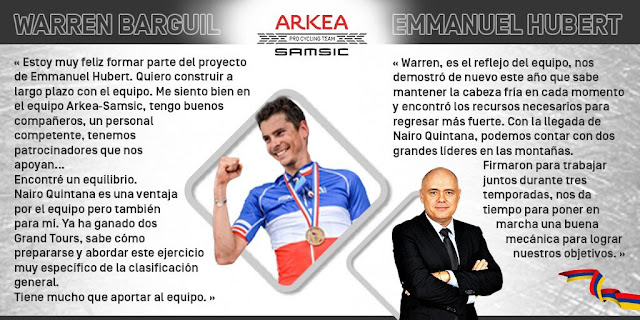
Cycling Weekly, Arkéa-Samsic have said that Quintana will act as a team leader alongside Warren Barguil, the French national road race champion.
General manager of Arkéa-Samsic, Emmanuel Hubert, said the team will now target winning a Grand Tour within three seasons, and that they now have the squad to rival the best WorldTour outfits.
“On paper, our 2020 team, composed of 28 riders, will have nothing to envy to the best teams of the World Tour. We give ourselves three seasons to make the project a reality by winning a Grand Tour,” he said.
“The alliance between Nairo Quintana and Warren Barguil must be an added strength for them. They must use one another to progress. Nairo Quintana won the Tour of Italy and the Tour of Spain and has three podiums in the Tour de France. I am also convinced that Warren Barguil has the ability to shine in the overall standings and it is on this path that we want to bring him.”
Hopes that Basque Pro Continental squad Euskadi Basque Country-Murias could continue in 2020 evaporated completely on Monday when the team sending out a communique confirming that it would cease operations at the end of this season.
"Our ongoing success saw us continue to grow but faced with the impossibility of continuing to do that with our own means, we are now obliged to stand aside," the Euskadi-Murias press release stated.
The disappearance of Euskadi-Murias comes despite success in the team’s biggest race of the season, the Vuelta a España, where Mikel Iturria took his first ever professional victory in the Navarran town of Urdax thanks to a spectacular lone attack.
The Basque Country will not be completely bereft of a local professional team as a result of Euskadi-Murias’ demise. Next year, Fundación Euskadi, currently racing at Continental level, is expected to move up to Pro Continental category.
Their roster is set to include Iturria, Mikel Aristi – winner of a stage in the Volta a Portugal and Tour de Limousin this year – Julen Irizar and Mikel Bizkarra, all of whom are currently with Euskadi-Murias.
El Euskadi-Murias ha hecho oficial que no continuará compitiendo la temporada que viene y por tanto desaparece, después de que su principal patrocinador, sobre el que se sostenía el proyecto, no continúe. Tampoco se ha encontrado un reemplazo.
Hoy podemos confirmar oficialmente que el equipo Euskadi - Murias no continuará la próxima temporada. El resumen de estos años es de enorme satisfacción. Los resultados deportivos obtenidos y el espíritu creado dentro del equipo, tanto por los diferentes deportistas que han estado con nosotros durante estos años, como por el staff técnico han hecho que el resultado haya sido de matrícula de honor.
Mathieu van der Poel (Netherlands) saw his dreams of winning the rainbow evaporate dramatically on Sunday in the elite men's road race. Headlines across the world were hastily re-written when Van der Poel was surprisingly dropped with 13km to go on the final lap of the race. The 24-year-old was quickly caught by the chasing field and finished 43rd in what was arguably the most grueling day of racing seen at a World Championships since Olso in 1993, Duitama in 1995 or Valkenburg in 1998.
Mathieu van der Poel: This is the first time that I've raced this distance in the rain. It was raining all day, it was very cold and it was a very hard race.
"All of sudden I had no strength anymore in my legs. I don't think that I made any mistakes today. I was in the right group but all of a sudden the tank was empty."
"It's a world championship that I'll remember for a long time. Every rider who rode it will remember it for a long time. I was in a good group and I did everything right but all of a sudden I had nothing more."
"I felt good, it was really good and then all of a sudden it was all gone. When I let the group go I was really dizzy and empty but in the last few kilometres, I felt good again. It was really strange."
We are EF Education First, the international pro cycling team on a quest to share our story and our sport with the world. We believe cycling is for everyone – so this season, we’re tackling new races and rides around the globe. Because that’s where everyone is.
“EF’s commitment is to bring different cultures together, to spark mutual understanding around the ways people and communities approach and see life. The goal is to promote empathy among people of diverse backgrounds, and inspire new ways of thinking which together can help make the world a little better. EF Pro Cycling is a platform that embodies this spirit, and which helps show how positive things happen when people explore the world.” - Edward Hult, CEO EF North America.
With a strong global presence in more than 100 countries, EF provides opportunities for people of all ages and backgrounds to explore the world.
We believe exploration is a transformative form of education, and that the more we seek out new places, the more we’re able to grow as individuals and connect with others. These experiences change how we think, act and feel, inspiring the kind of empathy that makes the world a better place for us all.
Much like exploring the world, cycling unites people from different backgrounds to achieve great things together.
In 2019 the EF Education First team is embarking on a journey to spread this message – and not just to pro cycling fans. In addition to prestigious WorldTour races like the Tour de France, the EF team will participate in popular amateur cycling events around the globe.
Taylor Phinney, Team Rider: To be racing for a team that is embracing this kind of a mantra is super special
“I often think about how I could spend the rest of my life moving around this planet, seeing different things that I wouldn’t see everyday, and I sort of feel like I need to start doing that now. To be racing for a team that is embracing this kind of a mantra is super special and I’m really grateful to be involved and I want to help to grow that as a concept and, to be the one who’s at the forefront of the exploring.” – Taylor Phinney, Team Rider
Higuita takes stunning first WorldTour win at the Vuelta
‘During this Vuelta, I learned to never give up’
Every morning during the team meeting on the EF Education First bus, sport director Juanma Garate outlines the team plan to his depleted Vuelta a España squad. Only five riders remain from the eight starters. Hugh Carthy, Rigoberto Urán, and Tejay van Garderen were forced out of the race with injuries in the first week.
The crashes took whatever plans the team had and threw them out the window. The five riders left in the race, without their team leaders to look after, were tasked with stage hunting across Spain, Andorra and France. No small ask.
Vuelta a España 2019: Stage 18 | EXTENDED HIGHLIGHTS | NBC Sports
“Everybody knew that we had a really nice opportunity today, but where do you find the motivation for the guys when you are saying more or less the same thing for two weeks?” wondered Garate. “I felt that. I know they did. This was the last opportunity to win a stage. I told them that, and I told Sergio, his life would change if he did.”
Sergio Higuita
Sergio Higuita, the 22-year-old neo-pro who got his WorldTour call up in May. The Vuelta is his maiden Grand Tour, and in Becerril de la Sierra on Thursday, Higuita scored his first WorldTour win.
“It’s a dream to be at the Vuelta, riding a Grand Tour,” said Higuita. “And now, winning a stage, it’s very important. It’s the biggest win of my sporting career.”
“To win one stage in a big Tour, it is really special,” Garate said. “Especially when you are 22-years-old, especially when everyone is talking about you and what you can do in the future. He’s a big guy even if he’s really small.”
Higuita launched his race-winning attack over the top, 52-kilometers from the finish, with Garate in his ear, urging him forward.
“I asked him to go,” said Garate. “It was the only chance we had. Go back, breathe, then go. Right after the top, he had to go. He did it. He dropped everyone. It was so cool.”
Gap gained, Higuita next had to hold off his chasers – the breakaway riders and the general contenders who were throwing attacks in his wake.
“The truth behind someone never surfaces when things are good but instead when hard things hit,” said EF Pro Cycling’s CEO, Jonathan Vaughters. “Today, we saw the truth behind Sergio.”
“During this Vuelta, I learned to never give up. After the bad moments that you have during a Grand Tour, each day is a new day and any day you can finish with a victory,” Higuita added. “I showed resiliency because yesterday I had a very, very difficult day and today I won the stage. I took it as it came and turned a bad situation into a good one.”
The Vuelta has been a rough road, no doubt — but it’s in the moments when things aren’t perfect that a team finds out what it truly is, and what it can be.
The head of USA Cycling, Steve Johnson, is heading to France to watch the Tour de France, and he is not there just to watch Lance Armstrong’s comeback attempt after a three-year retirement.
To Johnson, this means the work that USA Cycling has done over the last 10 years has begun showing on an international stage. In an interview, Johnson talks about the growth of Europe’s sport in the United States and the role Armstrong’s career has played.
Q. Can you quantify the impact of Armstrong on cycling in the United States?
A. From our perspective, Lance has absolutely put the sport of cycling on the radar screen of a lot of young potential cyclists. He legitimized the sport. He demonstrated to an American audience that you can be an international hero, earn a seven-plus-figure salary, have the endorsements, do all the things that American sports heroes are known for. You look at that decision-making matrix that goes on in the heads of young prospective talented athletes, they’re asking themselves, whether they know it or not, where are the opportunities? What Lance has done is to clearly demonstrate that there are legitimate professional opportunities in the sport of cycling. As a result of that, we’ve seen a dramatic increase in the number of individuals who have decided to become bike racers; our junior numbers have doubled since 2000.
Lance has provided the opportunity for almost a prospective chronological study of the impact of an identifiable hero or icon on a sport like cycling. He was in the sport and successful for seven years and then out for three and now he’s back in. While Lance was at the top of the sport, our annual growth rates were, in terms of membership numbers, around 5 percent. When Lance retired three years ago, our growth did drop down to about 3 percent for a couple of years. Now Lance is back and our growth rates are back to 4.5 percent or close to 5. He definitely has an impact. Our membership numbers have more than doubled since 2002. Our number of races have gone up dramatically. Our number of clubs, all the things that you associate with growth of a sport, all those indicators are trending upward.
 Genioux.com Corporation, "genioux facts", June 2, 2021